How BYD forced Ferrari to make the Apple Car
When Apple quietly killed Project Titan (its decade-long secret attempt to build an electric car) in early 2024, the tech world collectively shrugged. Apple had reportedly spent billions of dollars and employed hundreds of engineers chasing the dream of a beautifully designed, software-first electric vehicle. The company was reportedly in talks for joint production with the likes of Honda, Hyundai, and Kia. However, none of these automakers wanted to be Apple's manufacturing partner, and with autonomous driving being impossible to crack on schedule, the project eventually died without ever seeing the light of day. It seemed like the "Apple Car" was destined to remain one of Silicon Valley's great "what ifs."
Fast forward just two years, and something extraordinary has happened. The Apple Car finally got made, although it has a prancing horse on the bonnet instead of a bitten apple on the boot.
On May 25, 2026, Ferrari unveiled the Luce (pronounced looo-chay and Italian for "light"), its first fully electric vehicle, at a dramatic launch event against the soaring backdrop of the Vela di Calatrava in Rome. And the car shows fingerprints that are unmistakably those of one man: Sir Jonathan Ive, the legendary designer who spent over two decades at Apple shaping the iMac, the iPod, the iPhone, and pretty much everything else that made Apple the world's most admired company for technology design.
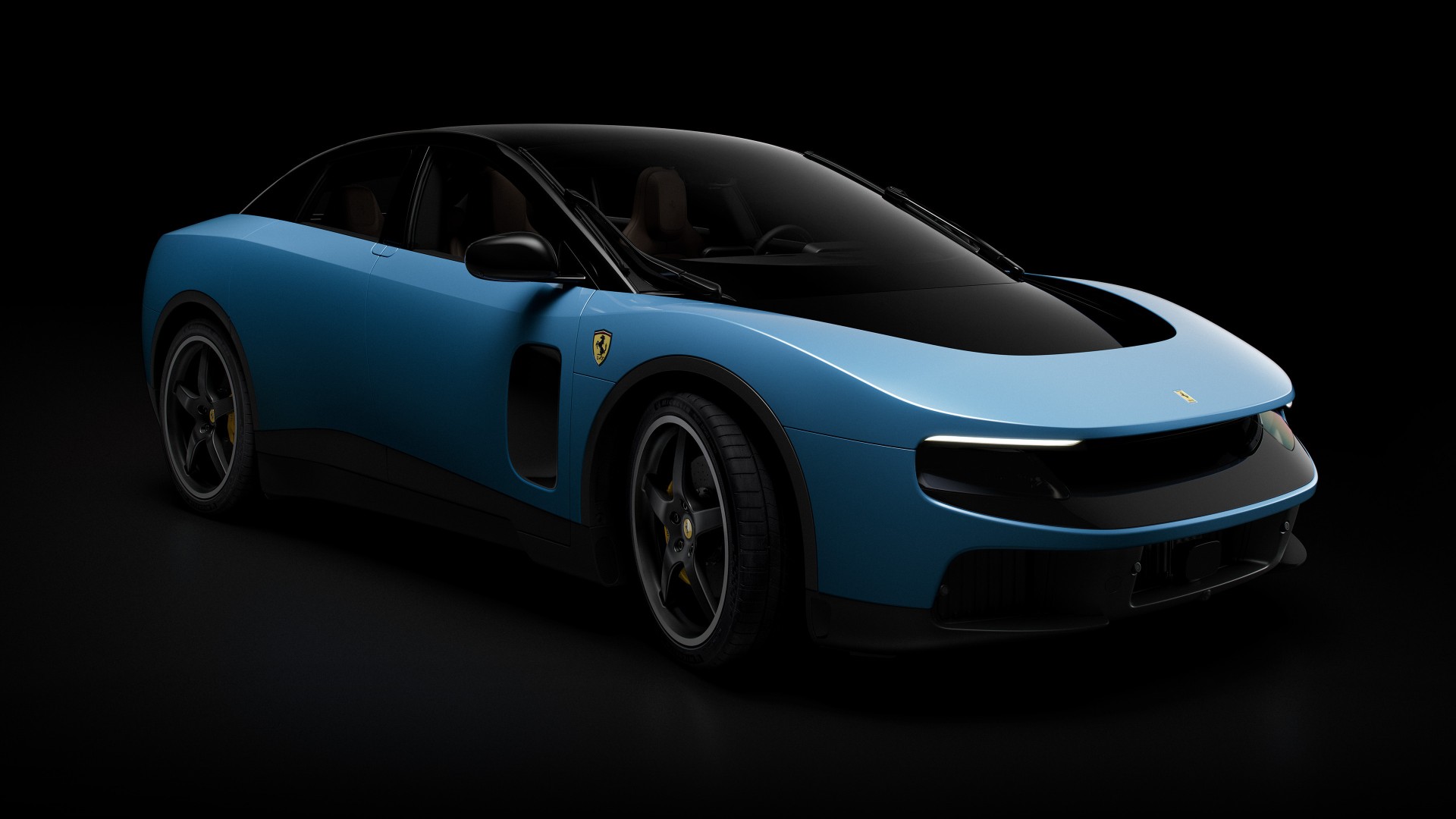
Ferrari Luce Exterior (source: Ferrari.com)
What is the Luce?
The Luce is unlike any Ferrari that has ever existed. It is a four-door, five-seat grand tourer and only the second four-door car Ferrari has ever made, after the Purosangue SUV (Italian for "pure blood"). With a starting price of €550,000 (~$640,000), it is over five metres long, weighs more than 2.2 tonnes, and packs four electric motors, one per wheel. The sports car is capable of producing a staggering 1,113 horsepower that enables a top speed above 310 km/h. It comes with a 122 kWh battery that delivers a range of over 530 kilometres on a single charge and was developed in partnership with South Korean firm SK On.
Ferrari has also built a bespoke 880-volt platform specifically for this car, which was developed entirely in-house at a brand new "E-Building" at its factory in Maranello. This platform draws on motor technology originally developed for the track-only F80 hypercar, along with Ferrari's extensive experience in Formula 1 and the FIA World Endurance Championship. The result is what Ferrari calls its most "spacious and versatile" car ever, without any compromises on performance.
But if the engineering is impressive, the design is both jaw-dropping and has been extremely polarizing since it launched. It also feels deeply familiar because of the involvement of the hands that designed it.
The Apple Car that never was
When Jonathan Ive left Apple in 2019, he founded a creative collective called LoveFrom, alongside his longtime collaborator, Australian industrial designer Marc Newson (who also happens to be a car enthusiast with a lifelong obsession with Ferrari). Ferrari Executive Chairman John Elkann (who has known both Ive and Newson for many years) approached LoveFrom about collaborating on the car that would define Ferrari's electric era. What followed was a five-year partnership that resulted in the Luce.
The influence of Ive's design sensibility is impossible to miss. The exterior is characterized by a smooth, continuous, shell-like form with a large curvaceous glasshouse sitting atop aluminium body panels. It has two floating aerodynamic wings at the front and rear that appear to have been extruded from the same single teardrop-shaped mould. Transparent front and rear light panels sit flush with the primary surfaces, disappearing entirely when switched off to preserve the purity of the form. The wheels are 23 inches at the front and 24 at the rear, the largest ever fitted to a production Ferrari. They come in either a forged open five-spoke design or a turbine-style aero wheel that would not look out of place rolling out of an Apple Store.
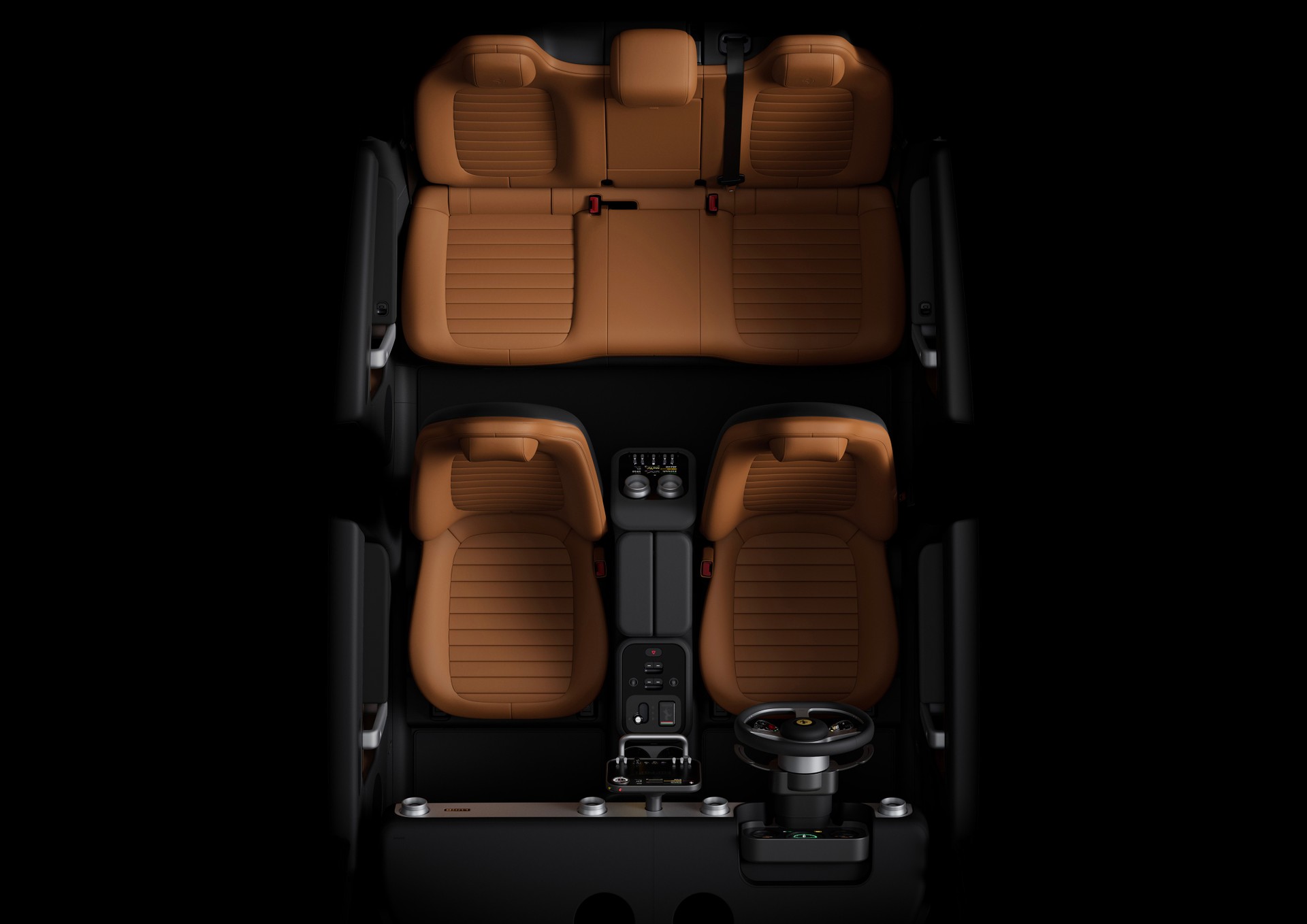
Ferrari Luce Interior (source: Ferrari.com)
Step inside, and Ive's minimalistic philosophy takes over completely. The interior is dominated by recycled anodised aluminium, Gorilla Glass surfaces, and tactile mechanical buttons, dials, and toggles that are designed to be operated purely by feel. This seems to be a deliberate counterpoint to the touchscreen-heavy approach favoured by Tesla and every other major EV brand. The instrument cluster uses two OLED panels layered on top of each other with physical needles sandwiched in between, creating a hybrid analogue-digital display that feels both futuristic and nostalgic at the same time. The three-spoke steering wheel is machined from 100% recycled aluminium.
Car and Driver said: "If it wasn't for Ferrari's prancing horse logo, you'd probably think you were looking at photos of the Apple Car. There is brushed aluminum everywhere."
The Ferrari Luce is probably closest to what Project Titan might have looked like if Apple had actually pulled it off. The irony is really interesting though: the Apple Car never happened because Apple couldn't find a willing manufacturing partner. But Jonathan Ive found one in Ferrari — a company that, unlike the automakers Apple approached, had its own compelling reason to bet everything on making the most desirable electric vehicle in the world.

Ferrari Luce Dashboard (source: Ferrari.com)
Enter BYD, stage left
To understand why Ferrari (a company whose CEO once reportedly said it would "never" make a fully electric car) went all-in on the Luce, you have to understand what has happened to the global luxury car market over the last three years.
China used to be Ferrari's most important growth market. Then, almost overnight, it wasn't. Ferrari's shipments to mainland China, Hong Kong, and Taiwan fell 13% in the first nine months of 2025 alone. Across the broader European luxury segment in China, the numbers were even worse: Mercedes-Benz sales collapsed 27% year-over-year in Q3 2025, and BMW combined with Mini dropped over 11% in the first nine months of the year.
The reason is no mystery. Chinese consumers, particularly the younger affluent ones, stopped seeing European luxury badges as aspirational. Instead, they turned to homegrown brands that offered comparable, and in many cases superior, technology at dramatically lower price points. The ringleader of this disruption was BYD (which, funny enough, stands for Build Your Dreams).
Most Western consumers either don't know BYD, or still think of them as a maker of affordable electric hatchbacks. However, that perception is dangerously out of date. BYD launched its ultra-luxury sub-brand Yangwang in 2023, and it now makes the U9, an electric supercar with four motors producing 1,288 horsepower, with a 0-100 km/h time of 2.36 seconds and a top speed of 392 km/h that rivals many Ferrari models. It is priced at just $230,000, or about a third of what the Luce costs. BYD has now confirmed it is bringing Yangwang to Europe, which will create a major face-off between the U9 and the Luce in the years to come.

Yangwang U9 (source: YangwangAuto.com)
BYD's premium sub-brand Denza has already launched in Europe with sports cars competing with the likes of Porsche, Ferrari, and McLaren. BYD's European sales have tripled in the opening months of 2026 and as one automotive analyst put it: "When a BYD Seal offers comparable performance to a Porsche Taycan at one-third the price, heritage badges lose their pricing power."
Porsche is already in retreat as Taycan sales have gone soft, the electric Macan has underperformed, and development of an electric 718 has been scaled back. Lamborghini, after initially committing to a fully electric future, has also dialed back its ambitions. These brands tried to fight BYD on price and technology, and found it was a battle they simply couldn't win.
Ferrari's audacious bet
Ferrari's answer to BYD's threat is the Luce, but it is a bet so audacious that even the company's own former chairman, Luca di Montezemolo, has publicly criticized it. Italy's Deputy Prime Minister Matteo Salvini was equally unimpressed, writing on X: "Electric, outrageously expensive (550 thousand euros!) and, from an aesthetic point of view, it speaks for itself… It looks like anything but a car from the Prancing Horse."
However, Ferrari CEO Benedetto Vigna, who unveiled the car to over 200 journalists in Rome, appears to be unperturbed. "It's the result of five years of work," he told the assembled press, with the quiet confidence of someone who knows that Ferrari has never competed on value.
And that, really, is the entire logic of the Luce in a nutshell. Ferrari cannot, and should not, try to out-engineer BYD on performance per dollar. The Yangwang U9 has more horsepower than the Luce. It is faster in a straight line. And it costs less than half the price. On raw numbers, Ferrari loses that fight before it starts.
But Ferrari's real competitive moat has never been horsepower figures. It has always been desire that drives the irrational, emotional, and aspirational pull of the brand. And in the electric era, where every new electric vehicle is fundamentally a software problem rather than a mechanical one, the battlefield has shifted from engineering to design, brand identity, and user experience. That is Jonathan Ive's territory and it's the fundamental reason behind Ferrari's collaboration with his firm, LoveFrom.
The Luce is Ferrari's argument that the next generation of wealthy buyers will be people who grew up with Apple products, who care deeply about how things look and feel and integrate with their digital lives, and who might be willing to pay a €550,000 premium for a car that feels like an iPhone on wheels. The smooth circular AC vents, the Corning glass screens, the tactile aluminium buttons, the hybrid analogue-digital instrument cluster: every detail of the Luce whispers "Apple" while screaming "Ferrari."
So, did BYD force Ferrari into making the Apple Car?
Not directly, of course. Ferrari's executives would rightly point out that Jonathan Ive and John Elkann had been discussing a collaboration long before BYD's Yangwang became a household name in China. And Ferrari was always going to have to confront electrification eventually, regardless of what was happening in the world's largest car market.
But the timing and the form of the Luce, including the decisions to make it a five-seater rather than a traditional two-seat sports car, going for maximum opulence rather than maximum performance, and bringing in the world's most famous designer from outside the automotive world, are all choices reflecting a company that was watching the global luxury car market get disrupted from below. It appears that Ferrari has concluded that its only safe harbor is at the very top with a level of design, craftsmanship, and cultural cachet that BYD, or any other upcoming foreign automaker, simply cannot replicate overnight.
In that sense, BYD did not just force Ferrari to go electric. It forced Ferrari to become something it had never been before: a technology-lifestyle brand whose designer now shapes its future. The Apple Car never happened. But the Ferrari Luce, with Jonathan Ive's fingerprints all over it, might just be the next best thing.


Comments
Post a Comment